The Ritual of Self-Recognition
An exhibition that finally comes to life as a whole
This article is a reproduction of the excellent testimonial by DANIEL BENOIT CASSOU linked below.
After workshops in 2022 and 2024, Marjolein Dallinga has made it a tradition to return to Uruguay this spring of 2026 to lead workshops that have been very successful!
Montevideo, Uruguay
April 26 to May 2, 2026: Immersive Experience
Immersive experience, felt, natural dyes and nature, Marjolein Dallinga, April 26 to May 2, 2026; Altos de la Serena, Costa de Rocha
There is something rare — and therefore precious — about this textile art exhibition at Artesia: the works do not clash, they engage in dialogue. Not through any obvious curatorial choice, but thanks to a tacit agreement between three artists who understand that textiles are not a technique, but a language.
In its intimate, small, and carefully arranged space, Artesia excels once again in its art: subtly weaving connections between the local and the international. This time, with Andrea Bustelo, Ludmila Maddalena, and Marjolein Dallinga. Three geographies, one single pulse.
The common thread: the tangible experience of the material.
The starting point is clear: textiles as an expanded territory. But what is most interesting is how each artist explores it in a different direction without breaking the thread.
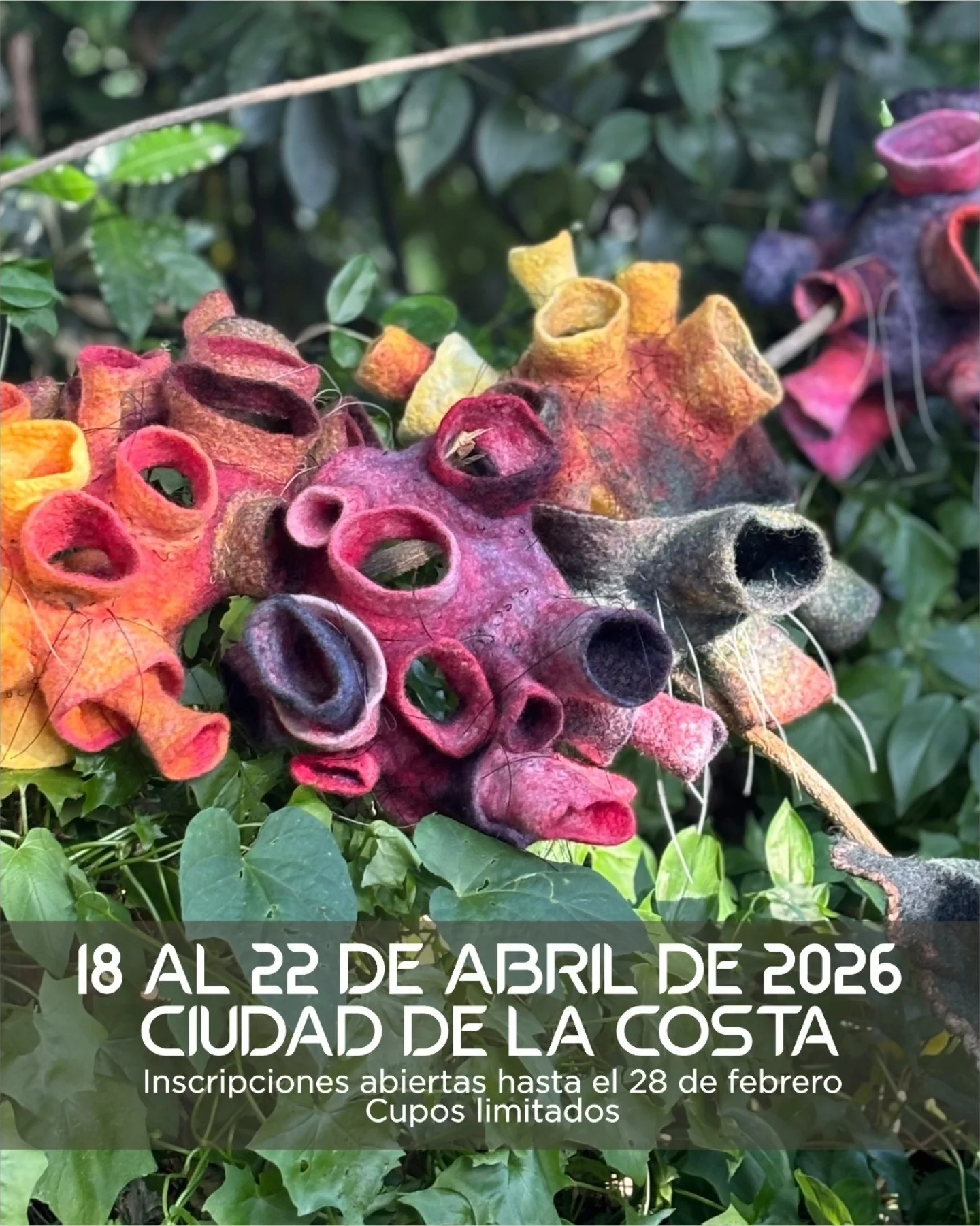
Dallinga works from the organic and the visceral, using felt as a body, as a vestige, as a reconstruction.
Maddalena navigates between the botanical and the ritualistic, employing plant-based dyes to translate an inner landscape.
Bustelo, for her part, works from affective memory, using objects laden with history that are reactivated through touch.
The result is not simply a collection of works, but a sensory system where fragility, ethereal quality, traces, and touch appear almost simultaneously. All without stridency. All on the verge of disappearance.
Marjolein Dallinga: The Body as a Territory of Mourning
Dallinga's works are the most powerful, not because of their number, but because of their emotional weight.
"Black Heart" is not a metaphor; it is a direct intervention in the face of loss. The heart does not represent, it substitutes. The felt accumulates the pain until it becomes tangible. The same phenomenon occurs in "Red Heart," where this affective core shifts toward encounters with other artists, where mourning is transformed into connection.
In “Spine,” the reference to the whale introduces a powerful idea whose structure is rooted in memory. We don’t see the animal, but we feel its absence, organized into form.
And then there are the lighter works — “Anemone,” “Bubbles”— where the artist softens the intensity without losing any of the depth. Another Dallinga is revealed, a Dallinga who understands that the ephemeral can also be an archive.
Her biography explains this simply. Trained in the Netherlands, she immigrated to Canada and discovered that feeling was her central language. But what matters is not the journey, but how she uses it to transform experience into matter.
Ludmila Maddalena: When the Landscape Reveals Itself Within
If Dallinga works from the wound, Maddalena works from listening.
“Inner Landscape” is one of the exhibition’s key works. Not because of its scale, but because of its ability to abolish the boundary between body and environment. The use of linen, wool, and plant-based dyes is not decorative; it is conceptual. Here, the plant does not illustrate; it speaks.
“The Oracle of Flowers and Plants” takes this logic even further. It is not a finished work, but a device. Something that is activated in relation to the viewer. The idea of a plant guide might seem naive elsewhere; here, it takes on its full meaning because it is based on a real, almost ritualistic process.
Her practice, between Argentina and the Sierra de Rocha, confirms this orientation, exploring natural fibers, collective experiences, and the intersections between art and territory. Maddalena does not represent the landscape; she integrates it.
Andrea Bustelo: Memory as Living Matter
In Bustelo’s work, a quality often absent from textile art is revealed: emotion without sentimentality. A true tour de force.
Her works originate in concrete objects — a handkerchief, a tablecloth, a trousseau — but avoid any easy nostalgia.
In “Sara,” the act of finishing her grandmother’s unfinished embroideries is not a tribute, but rather a conversation interrupted and then resumed.
“Feeling” is perhaps her most direct work. A found object transformed into a raw statement.
In “After-Dinner Conversation,” the felt work deconstructs the idea of an immaculate domestic sphere. Cracks, wear, and traces of time appear. A lived, not idealized, experience.
And “1964” introduces a more linear narrative — a love story — but one carried by the material, not by the story itself.
Bustelo is certain of one thing: memory is not an archive, it is a process. And textiles are her best tool.
When connection ceases to be discourse
The true success of the exhibition lies not in the individual works — effective though they are — but in what unfolds between them.
Connections emerge:
Dallinga's hearts engage in a dialogue with Bustelo's emotionally charged objects.
Maddalena's dyes resonate with the organic materials of both artists.
The idea of a trace permeates all three practices.
Small scale, intense experience
The gallery is small. But that's an advantage.
There's no possibility of distance, and the works assert themselves through touch, through proximity. The space is warm, almost intimate, and invites a slower pace. Something that contemporary art often avoids — and which, here, is appreciated.
It's rare to see a group exhibition where the concept isn't merely a pretext. Yet that's precisely the case here.
Three artists, three paths, a shared language: textiles understood as body, memory, and territory.
Without grandiloquence. Without fanfare.
And, for once, without sterile competition between the works.
Everything is understood. And felt more intensely.
Well done to the whole team!
Link to Daniel Benoit Cassou's video: